
Finland has 5.5 million people and roughly 3.3 million saunas. That’s not a quirky statistic; it tells you something about the role the sauna plays in Finnish life. This isn’t a luxury add-on. It’s infrastructure. And understanding why explains a lot about what a proper sauna session is actually supposed to feel like.
Where it started
The Finnish sauna is at least two thousand years old, possibly older. Early versions were simple: a pit dug into a hillside, a pile of stones heated by fire, water thrown on to create steam. The word sauna itself is one of the oldest words in the Finnish language; it predates most of the vocabulary borrowed from surrounding cultures.
In early Finnish society, the sauna was the most hygienic space in any household, cleaner than the home, more consistently warm, and the only place with reliable hot water. Babies were born in saunas. The sick were treated there. The dead were washed and prepared there. It held a role that was simultaneously medical, ceremonial, and social.
“The sauna is the poor man’s pharmacy”, a Finnish proverb, dating back centuries. The idea that heat, sweat, and rest could treat most of what ailed you wasn’t mysticism. It was practical experience accumulated over generations.
In 2020, UNESCO added Finnish sauna culture to its list of Intangible Cultural Heritage, recognising not just the practice, but the entire ecosystem around it: the rituals, the etiquette, the way it structures social life and community.
The numbers behind it
3.3M
Saunas in Finland, roughly one for every 1.7 people
85–100°C
Typical temperature inside a Finnish sauna, dry heat, not humid
10–20%
Humidity at rest, rising sharply when löyly is thrown
1× week
How often most Finns go to the sauna, many more frequently
Löyly, the soul of the sauna
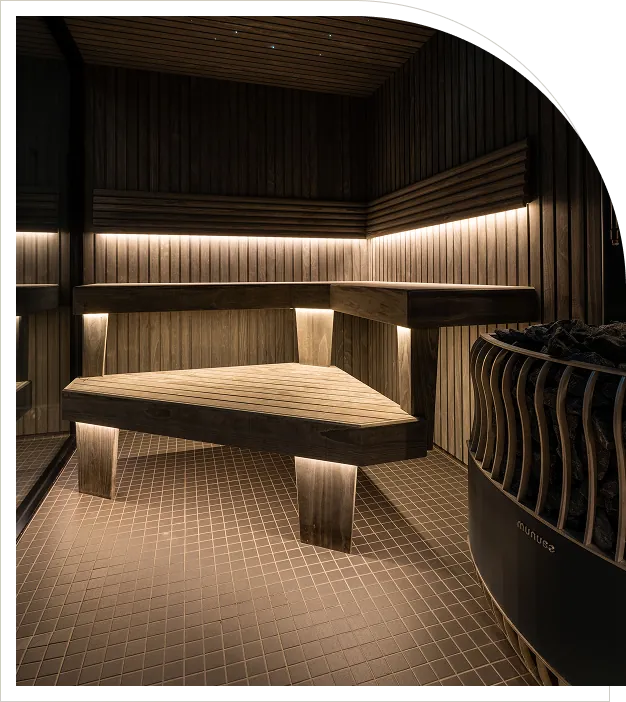
The concept that separates a Finnish sauna from a generic hot room is löyly (pronounced roughly “loy-lu”). When water is poured over the heated stones (kiuas), it produces a wave of steam that rises and rolls across the ceiling before descending around the bathers. The air temperature doesn’t change dramatically, but the perceived heat intensifies immediately, and the humidity opens the pores and airways in a way dry heat alone doesn’t.
The quality of löyly depends almost entirely on the stones and the heater. Poor stones, too smooth, too small, insufficiently heated, produce a weak, watery steam that dissipates quickly. Good stones, properly stacked and brought to temperature slowly, produce a soft, enveloping steam that holds in the room. Finns are particular about this in a way that can seem obsessive to outsiders, and entirely reasonable once you’ve felt the difference.
Traditional additions to the water, a splash of birch tar, a few drops of tar or pine resin, are still common in Finnish households. The scent becomes part of the ritual as much as the heat.
The ritual: how a proper session is structured
A Finnish sauna session isn’t a single sit in a hot room. It’s a cycle, repeated two or three times, with deliberate rest built in between. The rhythm matters; the contrast between heat and cold is where most of the physiological benefit comes from.
- Rinse before entering. In Finnish culture, you shower before the sauna, not after. You enter clean. This is as much about respect for shared space as it is about hygiene.
- Sit and heat. Start lower if you’re new; heat rises, so the upper benches are significantly hotter. 10 to 20 minutes is typical for one round. You should be sweating well before you leave.
- Throw löyly. Water is ladled slowly onto the stones. The traditional Finnish approach is small amounts, often keeping the steam consistent rather than blasting the room all at once.
- Cool down. Step outside, jump in a lake, roll in snow if it’s winter, or take a cold shower. The cooling phase is not optional; it’s half the session. The body’s response to rapid temperature change is when circulation improves and the nervous system resets.
- Rest. Sit quietly between rounds. Drink water. Don’t rush back in. The rest interval is when the body consolidates the heat response; cutting it short reduces the benefit.
- Repeat 2–3 times. Then a final cool-down, a long rest, and, traditionally, a meal or a drink with whoever you shared the sauna with.
The social dimension
In Finland, the sauna is where conversations happen that don’t happen anywhere else. There’s a saying: “In the sauna, all are equal.” The heat is the same for everyone. There are no roles, no hierarchies, no performance. Historically, business deals were made in saunas, peace negotiations were held there, and difficult family conversations were finally had.
This isn’t accidental. The environment strips away pretence. When you’re hot and undressed and sitting in silence with someone, the social scaffolding falls away, and something more honest tends to come out. Finns talk about the sauna as a psychological threshold, a place where people become more themselves.
The communal sauna, rather than the private one, plays a particular role in this. Sharing the space with people you don’t know and falling into the same rhythm, the same heat, the same silence, the same cooling, creates a low-key sense of belonging that’s harder to manufacture in other settings.
The health evidence
Finnish sauna culture has been extensively studied, partly because Finns have been doing it long enough and consistently enough to produce meaningful longitudinal data. A landmark study from the University of Eastern Finland, following over 2,000 middle-aged men for 20 years, found that regular sauna use (4–7 times per week) was associated with significantly reduced risk of cardiovascular disease and all-cause mortality, effects comparable to moderate aerobic exercise.
Other research has found associations with improved blood pressure, reduced inflammation markers, enhanced recovery from muscle soreness, and better sleep. The evidence is strong enough that Finnish cardiologists routinely recommend sauna use to patients without cardiac contraindications.
The mechanism isn’t fully understood, but the leading theory involves repeated cardiovascular stress adaptation. The heart rate rises in a sauna to a level similar to light-to-moderate exercise, and the body adapts to that stress over time in the same way it adapts to physical training.